Llais V2 builds directly on the earlier Llais project, which explored the potential of AI-driven lip-syncing as a way of making Welsh-language content more accessible to wider
audiences. While the initial phase focused on feasibility and ethical considerations, this second phase shifted towards practical application. The emphasis moved from asking whether the technology could work, to understanding how it might function within real production environments.
This meant developing not just the technology itself, but the surrounding processes that would allow it to be used in a professional context. From the outset, the intention was to create something that could integrate into existing industry workflows rather than sit outside them. At the same time, the project remained grounded in the cultural and linguistic context that inspired it, with a particular focus on supporting the reach of Welsh-language media.
Download the Llais V2 Project Report
Project Objectives
The project was guided by a clear set of ambitions. It sought to develop a productionready pipeline for AI-assisted lip-syncing, to test that pipeline using real broadcast
material, and to explore whether the approach could form the basis of a viable commercial service.
Alongside the technical goals, there was an ongoing commitment to understanding how such a tool would be received by the industry. This included engaging with stakeholders, identifying potential barriers to adoption, and ensuring that the system was designed in a way that complemented, rather than disrupted, established creative roles.
In practical terms, the work focused primarily on Welsh-to-English localisation, while also considering how the same approach might be extended to other languages and markets in future.
Objectives
• Develop a production-ready AI lip-sync pipeline
• Automate key stages of the localisation process
• Test the system using real broadcast material
• Engage stakeholders to assess industry readiness
• Explore commercial models and pricing structures
Scope
• Welsh-to-English localisation (primary focus)
• Integration with existing post-production workflows
• Use of both archive and newly broadcast material
Building on the research and prototype developed in the Llais project, Llais V2 aims to refine and test the viability of the AI-driven lip-syncing process, working closely with industry stakeholders to establish a commercially viable business model.
The project will develop a new production pipeline, incorporating stakeholder feedback to create a market-ready solution. A key focus will be automating several manual elements, while working on real production material to showcase the technology.
Key Development Areas:
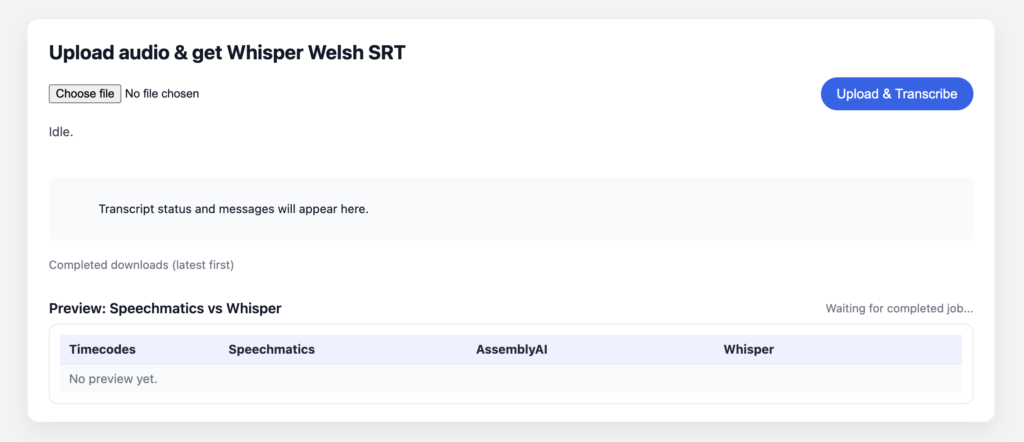
- Client-Facing Portal – A user-friendly platform to upload full video files, separated audio tracks, scripts, and outtakes.
- Automated Transcription & Segmentation – AI-driven tools to align footage with scripts, applying precise timecodes for segments.
- AI Lip-Sync Training – Further refinement of AI models to match actors’ lip movements.
- Final Editing & Quality Control – A post-processing workflow ensuring high-quality, natural results.
- Safeguarding employment by ensuring professional translators, dubbing artists, and writers remain integral to the process.
- Building strategic partnerships with broadcasters and content creators to expand Welsh-language media internationally.
- Real broadcast content will be used to validate the process, and multiple market segments will be explored to assess demand and pricing structures.
Stakeholder feedback has emphasised the importance of ensuring the product is fully developed and industry-ready before wider rollout. Llais V2 will prioritise creating a polished, scalable, and commercially viable AI localisation service for Welsh and international media markets.
Testing with broadcast content
Testing the pipeline using real broadcast material was one of the most valuable aspects of the project. It provided a realistic view of how the
technology performs under the kinds of conditions encountered in production.
Case Study 1: Ein Llwybrau Celtaidd / Our Celtic Connections
Broadcast: S4C / TG4 – May 2026
Presenter: Ryland Teifi
Production company: Tinopolis
• Mixed results depending on footage quality
• High-quality close-up footage performed well
• Challenges:
• Low resolution
• Fast cuts
• Lighting inconsistencies
Key Learning:
Scene-specific model training significantly improves output.
Examples: https://www.ypod.cymru/about/llais-v2-rd-llwybrau-celtaidd/
Case Study 2: Gwanas i Gbara
Broadcast: S4C 2010
Presenter: Bethan Gwanas
Production company: Telesgop
Archive (2010) content posed challenges.
Languages: English | French | Spanish
Issues:
• Low resolution (SD footage)
• Motion interference (hands, shadows)
• Visual artefacts (flickering)
Key Learning:
• Older archive footage may require additional VFX processing
• AI-assisted rotoscoping (e.g. SAM models) shows potential but still requires manual QA
Examples: https://www.ypod.cymru/about/llais-v2-rd-gwanas-i-gbara/
Non broadcast content
Broadcast Content Summary
Key Challenges
• Variability in footage quality
• Handling fast cuts and motion
• Audio alignment complexity
• Integration across different editing platforms
• Ethical and legal considerations
• Archive content limitations
Key Learnings
• Preparation of footage is critical
• Scene-specific training is more effective than general datasets
• AI cannot yet fully replace human oversight
• Industry adoption depends on seamless workflow integration
• Ethical frameworks must evolve alongside technology
Llais project: Technical Workflow & Pipeline Development
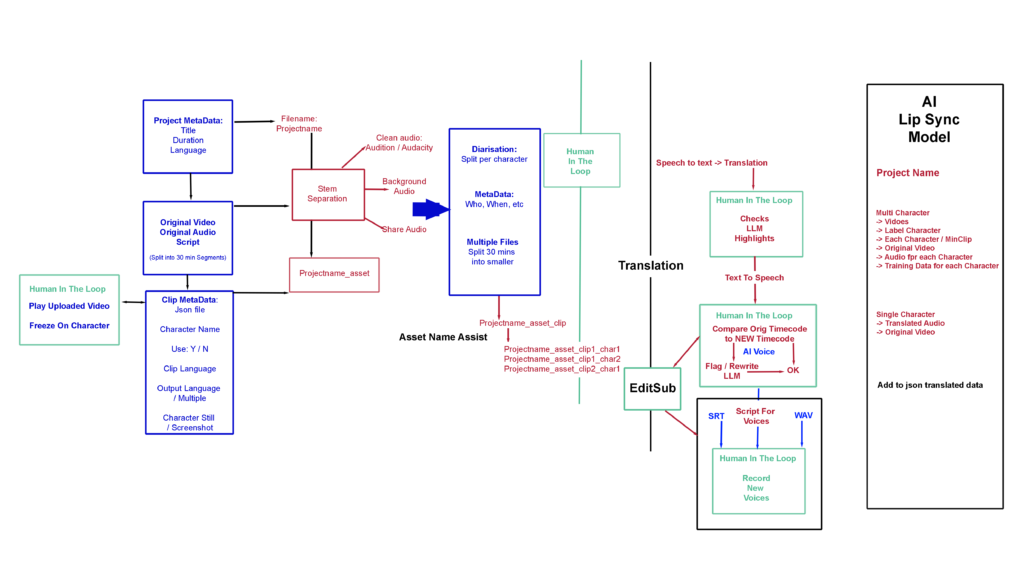
The Llais V2 pipeline consists of several modular stages:
Core Pipeline
- Ingest & Upload
- Media Analysis (transcription, diarisation, segmentation)
- Manual Review Interface
- Translation & Script Adaptation
- Audio Creation (ADR or AI voice)
- Audio Alignment
- Lip-Sync Processing
- Final QA & Delivery
Commercial potential & future development
Llais V2 has demonstrated that there is a credible commercial opportunity for AIassisted localisation. The ability to adapt content for different audiences more
efficiently has clear value, particularly for smaller language markets seeking to reach global viewers.
In addition to localisation, the technology offers potential benefits within postproduction itself, providing new ways to refine and adapt content without the need for
costly reshoots
The next phase of development will focus on working with broadcasters and independent production companies to produce pilot content. These collaborations will be critical in testing the technology in live production environments, refining the commercial model, and demonstrating its value at scale.
Download the Llais V2 Project Report
Development model screenshots
A significant portion of the work centred on developing a pipeline that could support the full localisation process from initial ingest through to final output. Rather than
treating lip-syncing as a standalone step, the project approached it as part of a broader workflow.
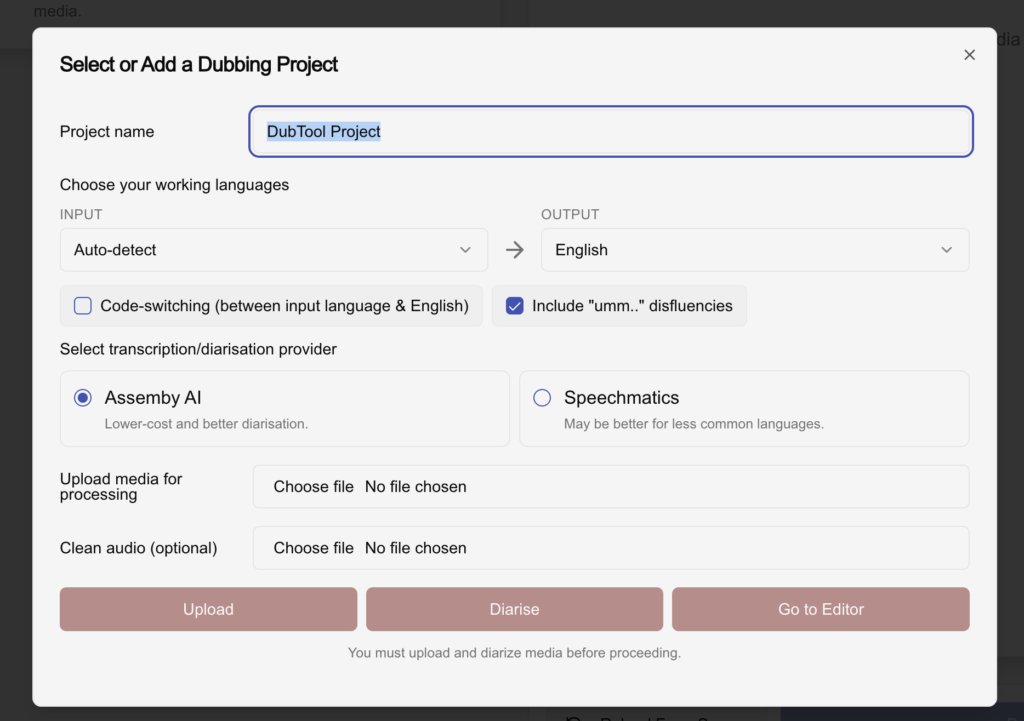
Dub Tool Model
Transcribes media, provides a translation model for the transcription to another language for preparation before lipsynch.
Model for translation assistance
Upload media and transciption – Compares translation text from AI sources.